Control and Coordination {Class 10th Biology}
Chapter: Control and
Coordination
Class: 10th Biology
Presented By: Dr. Priyanka Patade

Control and Co-ordination
in Animals
In animals, the nervous
system and hormonal system (endocrine system) are responsible for control and
co-ordination.
Receptors: Receptors are the specialized tips of the nerve fibres that collect the information to be conducted by the nerves.
Receptors are in the sense
organs of the animals.
Classification of
receptors

Receptors are classified
as follows:
1) Phono-receptors: These
are present in inner ear.
Functions: The main
functions are hearing and balance of the body.
2) Photoreceptors: These
are present in the eye.
Function: These are
responsible for visual stimulus.
3) Thermoreceptors: These
are present in the skin.
Function: These receptors
are responsible for pain, touch and heat stimuli.
4) Olfactory-receptors:
These are present in nose.
Functions: These receptors
receive smell.
5) Gustatory-receptors: These are present in the tongue.
Functions: These helps in
taste detection.
Nervous System
The nervous system is
composed of specialized tissues, called nervous tissue.
The nerve cell or neuron
is the functional unit of the nervous system.
It is
the nervous system which is mainly responsible for control and coordination in
complex animals.

Functions of the nervous
system
⏩ Nervous system receives
information from the environment
⏩ To receive the information
from the various body
⏩ To act according to
through muscles and glands
Neuron: Neuron is a highly specialized cell which is responsible for the transmission of nerve impulses.
The neuron consists of the following parts:
(i) Dendrites:
These are hair-like structures protruding out of the margin of cell body. Dendrites receive the nerve impulses.
(ii) Cyton or cell body: The cell body or cyton is somewhat star-shaped, with many hair like
structures protruding out of the margin. Cyton/soma processes the impulse.
(iii) Axon: Axon transmits
the impulse, either to another neuron or to muscles/glands etc. It ends in several hair-like structures, called axon terminals. The axon
terminals relay nerve impulses.
(iv) Myelin sheath: There is an insulator cover around the axon. This is called myelin
sheath. The myelin sheath insulates the axon against nerve impulse from the
surroundings. The impulse transmission is faster in myelinated neurons.
Neuron

Types of neuron⏩ Sensory neuron ⏪
⏩ Motor neuron ⏪
⏩ Association or relay neuron ⏪

Sensory neuron: These neurons receive signals from a sense organ.
Motor neuron: These neurons send signals to a muscle or a gland.
Association or relay
neuron: These neurons relay the signals between sensory neuron
and motor neuron.
Synapse is the gap between nerve ending of one neuron and dendrites of
another.
Transmission of nerve
impulse
Nerve impulses travel in
the following manner from one neutron to the next :
Dendrites → cell body → axon → nerve endings of axon → synapse → dendrite of next neuron.
A neuromuscular junction
(or myoneural junction) is a chemical synapse between a motor neuron and a
muscle fiber.
It allow the motor neuron to transmit a signal
to the muscle fiber, causing muscle contraction.
Questions
1. What are receptors? Explain the types of receptors along with their functions.
2. With a neat, labelled
diagram, explain the structure of neuron.
3. What are the types of
neuron?
4. Define synapse? Write
the path of transmission of nerve impulse.
↭↭↭↭↭↭↭↭↭↭↭↭↭↭↭↭↭↭↭↭↭↭↭↭↭↭↭↭↭↭↭↭
Human Nervous System
⏩ Central Nervous System ⏪
⏩ Peripheral nervous system ⏪
⏩ Autonomous Nervous System ⏪
⏩ Sympathetic Nervous System ⏪
⏩ Parasympathetic Nervous System ⏪

1. Central Nervous
System
The central nervous system
is composed of the brain and the spinal cord.
The brain controls all the
functions in the human body.
The spinal cord works as the relay channel for
signals between the brain and the peripheral nervous system.
2. Peripheral Nervous
System
The peripheral nervous
system is composed of the cranial nerves and spinal nerves.
There are 12 pairs of
cranial nerves. The cranial nerves come out of the brain and go to the organs
in the head region.
There are 31 pairs of spinal nerves. The
spinal nerves come out of the spinal cord and go to the organs which are below
the head region.
3. Autonomous Nervous
System
The autonomous nervous
system is composed of a chain of nerve ganglion which runs along the spinal
cord. It controls all the involuntary actions in the human body.
The autonomous nervous
system can be divided into two parts :
i)Sympathetic nervous
system.
ii)Parasympathetic nervous system.
i) Sympathetic Nervous
System:
This part of the
autonomous nervous system increases the activity of an organ as per the need.
For example, during running, there is an increased demand for oxygen by the
body. This is fulfilled by an increased breathing rate and increased heart
rate. The sympathetic nervous system works to increase the breathing rate and the heart rate, in this case.
ii) Parasympathetic Nervous
System:
This part of the
autonomous nervous system slows the down the activity of an organ and thus has
a calming effect. During sleep, the breathing rate slows down and so does the
heart rate. This is facilitated by the parasympathetic nervous system.
Human Brain
Human brain is a highly
complex organ, which is mainly composed of nervous tissue.
The brain is protected by
3 main layers –
⏩ The bony skull (cranium)
⏩ The cerebrospinal fluid
⏩ The meninges (Dura mater,
Arachnoid and Pia mater)

The human brain can be
divided into three regions, viz. forebrain, midbrain and hindbrain.
Parts of Human Brain
⏩ Fore-brain ⏪
⏩ Mid-brain ⏪
⏩ Hind-brain ⏪

Fore-brain: It is composed
of the cerebrum.
Mid-brain: It is composed
of the hypothalamus.
Hind-brain: It is composed
of the cerebellum, pons, medulla oblongata.
Functions of different
parts of the brain are
Cerebrum is responsible for reasoning, logic, emotions, speech, memory, visual
processing, recognition of auditory and taste stimuli, etc.
Cerebellum regulates and coordinates body movements, posture and balance.
Pons relays signals from hindbrain to forebrain.
Medulla Oblongata controls all involuntary movements like vomiting, sneezing, yawning,
heartbeat, breathing, blood pressure, etc.
Spinal Cord
Medulla oblongata
continues as the spinal cord which runs through the vertebral column and it
controls reflex actions.
Spinal cord
controls the reflex actions and conducts massages between different parts of
the body and brain.
The vertebral column, commonly called backbone, protects the spinal cord.
Questions
1. What is synapse? Write
the path of transmission along with their functions.
2. Explain the different
types of human nervous system.
3. How is human brain
protected?
↭↭↭↭↭↭↭↭↭↭↭↭↭↭↭↭↭↭↭↭↭↭↭↭↭↭↭↭↭↭↭↭
Reflex action
Reflex action is
a sudden, involuntary reaction of the body in response to stimuli.
For example, when your
hand touches a very hot electric iron, you move away your hand in a jerk. All
of this happens instantly and your hand is saved from the imminent injury. This
is an example of reflex action.
Reflex Arc: The path
through which nerves signals, involved in a reflex action, travel is called the
reflex arc.
The following flow chart
shows the flow of signal in a reflex arc:
Receptor → Sensory neuron → Relay neuron → Motor neuron → Effector (muscle)
The receptor is the organ which comes in the danger zone.
The sensory neurons pick signals from the receptor and send them to the relay neuron.
The relay neuron is present in the
spinal cord.
The spinal cord sends signals to the effector via the motor neuron.
The effector comes in action, moves the receptor away from the danger.

Types of responses
⏩ Voluntary ⏪
⏩ Involuntary ⏪
⏩ Reflex action ⏪
i) Voluntary: Controlled
by fore brain. Example: talking, writing.
ii) Involuntary:
Controlled by mid and hind brain. Example: heart beat, vomiting, respiration.
iii) Reflex action:
Controlled by spinal cord. Example: withdrawal of hand on touching a hot object.
Need for Reflex Actions- In some situations such as touching a hot object,
pinching etc. we need to act quickly, other our body would be harmed. Here
response is generated from spinal cord instead of brain. In this way, time for
taking action is reduced which save us from injury.
Limitations of Electric
communication/Nervous system
i) Electric impulse will
reach only to those cells that are connected by nervous tissue.
ii) After generation and
transmission of an electrical impulse, the cell takes some time to reset
mechanism before transmitting another impulse. So cells cannot
continuously create and transmit impulse.
iii) Plants do not have
any nervous system.
Chemical communication- It
helps in overcoming the limitations of electric communication.
Stimuli- The change in the
environment to which the organism responds.
Co-ordination: Working
together of various organs of an organism in a systematic manner to produce a proper response.
Neuron- Functional unit of
the nervous system.
Synapse- A microscopic gap
between a pair of adjacent neurons.
Receptor- A cell in a
sense organ which is sensitive to stimuli.
Motor nerves- It carries
the message from the brain to body parts for action.
Sensory nerves- It carries
the message from body to brain.
Brain- An organ present in
the skull which controls and regulates the activity of the whole body and is
known as president of the body.
Cerebrum- Main thinking
part of brain present in the forebrain area which controls all voluntary
actions.
Cerebellum- It is present
in the hindbrain area and helps in maintaining posture and balance of the body.
Medulla- It is present in
the hindbrain area and helps in controlling voluntary actions of the brain.
Spinal cord- It is a
cylindrical structure of nerve fibres enclosed in the vertebral column which
helps in the conduction of nerve impulses to and from the brain.
Endocrine System
The endocrine system is
composed of several endocrine glands.
A ductless gland is called
endocrine gland.
Endocrine gland secretes its product directly
into the bloodstream. Hormones are produced in the endocrine glands.
Hormone is mainly composed
of protein.
Moreover, unlike nervous control, hormonal
control is somewhat slower.

The list of endocrine
gland with the hormones names and their functions are given below:
i) Thyroxine: This hormone is secreted by Thyroid gland. The Thyroid gland is located
in Neck/Throat region regulates the metabolism of carbohydrates, fats and
proteins.
ii) Growth hormones: This is secreted by Pituitary (master gland). This gland is located in
Mid brain. It regulates growth and development.
iii) Adrenaline: This hormone is secreted by Adrenal gland. The adrenal gland is located
above both kidneys. It regulates blood pressure (increasing), heart beat,
carbohydrate metabolism (during emergency).
iv) Insulin: This hormone
is secreted by Pancreas. The pancreas are located below stomach. It reduces and
regulates blood sugar level.
v) Sex hormones: (a) Testosterone in males:
This hormone is secreted by testis. The testis is located in genital area. Its
changes are associated with puberty (Sexual maturity).
(b) Estrogen in females:
This hormone is secreted by Ovaries. The ovaries are located in lower abdomen
area. Its changes are associated with puberty (Sexual maturity).
Importance of iodine
Iodised salt is necessary
because iodine mineral is essential part of thyroxine hormone secreted by thyroid gland.
Thyroxine regulates
metabolism of carbohydrates, fats and proteins.
So, we must consume
iodised salt which is necessary for proper working of thyroid gland.
It’s deficiency causes
disease called goiter (Swollen neck).
Diabetes
Diabetes is a disease in which blood sugar level increases.
Cause of Diabetes
The disease is caused due
to the deficiency of insulin hormone secreted by pancreas that is responsible
to control blood sugar levels.
Treatment of Diabetes
Injections of
insulin hormone can help in the treatment of diabetes.
What is coordination in
plants?
Coordination is the
ability to use different parts of the plant together, smoothly and efficiently.
In plants, coordination is
due to the result of a chemical system, wherein plant hormones or phytohormones
have a major role.
Plants exhibit two types
of movements.
1) Growth-dependent movements
called the Tropic Movements. ( towards or away from a stimulus)
2) Non-growth dependent
movements called the Nastic Movements. ( independent of stimulus)
Tropic movements
These can be classified
again into 5 types.
⏩ Phototropism (light)
⏩ Geotropism (gravity)
⏩ Hydrotropism (water)
⏩ Chemotropism (chemicals)
⏩ Thigmotropism (touch)
Phototropism– It is the movement of
plants in response to light. The shoot system of a plant exhibits this
characteristic. The shoot moves towards the light.
Geotropism– It
is the movement of a plant part towards the soil. This is a characteristic
of the root system. The roots always move in
the direction of the earth’s gravity.
Hydrotropism– It is the
movement of a plant towards the water. The stimulus here is water.
Chemotropism– It is
the movement of plants in response to a chemical stimulus. A classic example of
this type of movement is the growth of the pollen tube towards the
ovule, during fertilization, in a flower.
Thigmotropism– It is
a directional movement in plants in response to touch. For e.g. the plant
tendrils climb around any support which they touch.
Nastic Movements
Nastic movements in plants
are not directional movements.
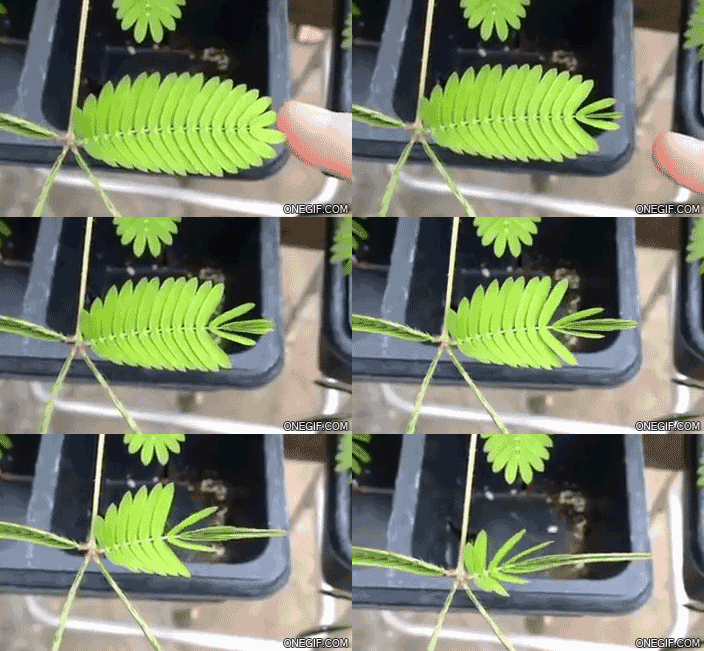
They are not dependent on stimulus and are
growth independent.
For example, the leaves of a touch me not
plant (Mimosa pudica), fold up immediately when touched. These kinds of
changes occur due to the changes in the amount of water in the leaves.
Depending on the quantity, they either swell up or shrink.
Plant hormones or Phytohormones
They are responsible for
the control and coordination of plants.
There are different types
of hormones, which affect the growth of a plant.
Phytohormones are chemical
compounds which are released by stimulated cells. These hormones are diffused
around the plant cells.
They have a role to play
in the cell division, cell enlargement, cell differentiation, fruit
growth, falling of leaves, ripening of fruits, ageing of plants etc.
The different types of
phytohormones are
⏩ Auxins
⏩ Gibberellins
⏩ Cytokinins
⏩ Abscisic acid
Auxins– They help in
the cell growth at the shoot tips. By elongating the cells, they help in the growth process.
Gibberellins– These
hormones are responsible for the cell growth in the stem, seed,
germination and flowering.
Cytokinin– They
promote cell division in plants. They also promote the opening of the stomata
and delay ageing in leaves.
Abscisic acid– This
hormone inhibits the growth of the plant. Therefore, it promotes dormancy in
seeds and buds. The detachment of fruits, flowers, and falling of leaves etc.
are promoted by this hormone.
↭↭↭↭↭↭↭↭↭↭↭↭↭↭↭↭↭↭↭↭↭↭↭↭↭↭↭↭↭↭↭↭


Comments
Post a Comment